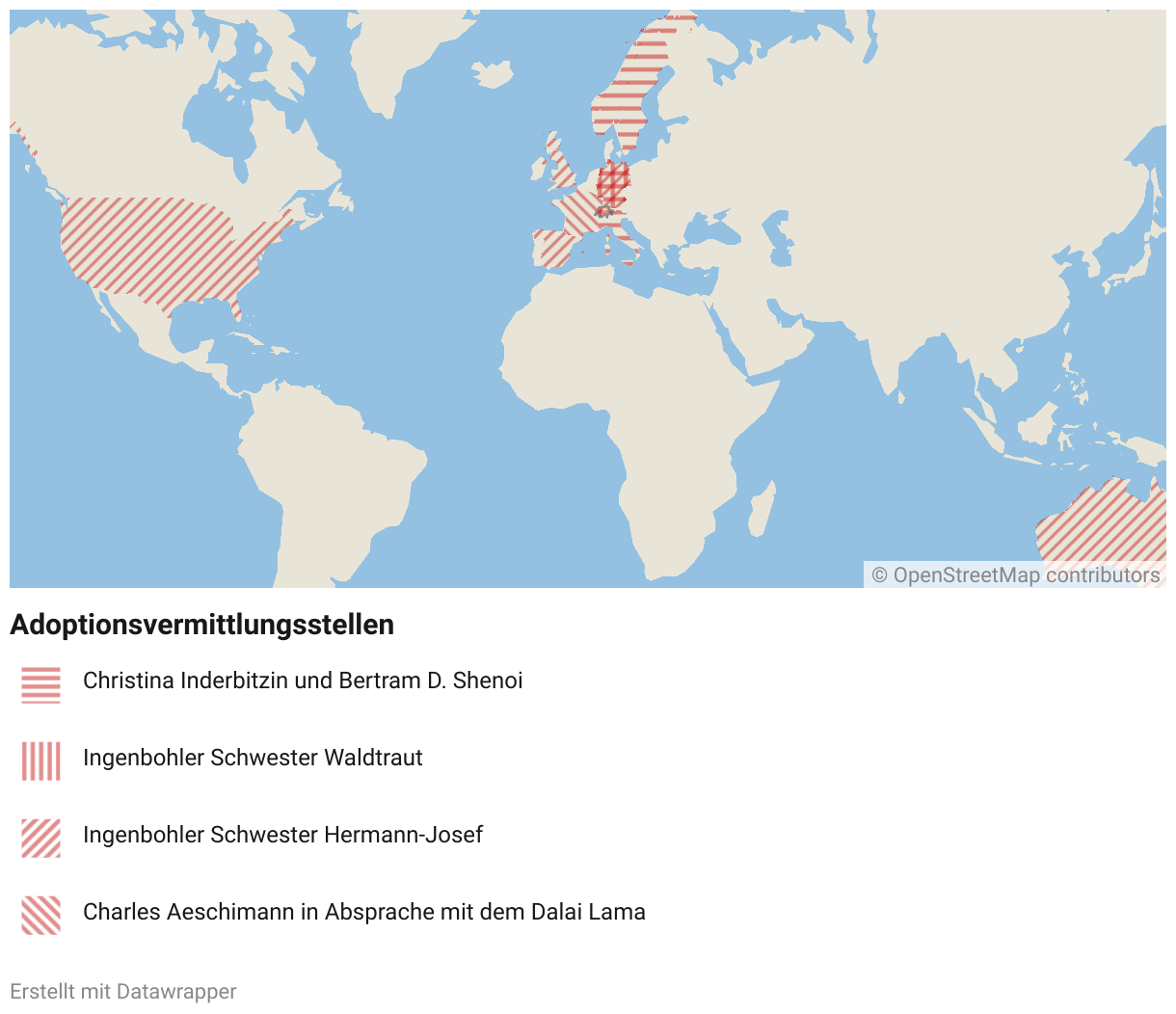
The first children to be brought to Switzerland from India for adoption came from Tibet. They had fled with relatives to Dharamsala in India in 1959 following the Chinese invasion and were placed with families in Switzerland at the beginning of the 1960s. This initiative was launched by the Swiss electrical engineer Charles Aeschimann, who held a leading position in the electricity company Aare-Tessin Aktiengesellschaft für Elektrizität (Atel) in Olten.[FN1 https://hls-dhs-dss.ch/de/articles/046708/2001-03-12/, accessed 20.5.2024.] Assisted by alpinist friends who were familiar with the Himalayas, he contacted the Dalai Lama and came to an agreement to allow 160 Tibetan girls and boys to grow up in Switzerland. The Dalai Lama wished them to return to their homeland as young adults, which is not what happened, as the 'Tibeterli' [little Tibetans] brought to Switzerland between 1961 and 1964 as part of the 'Aktion Aeschimann' initiative were adopted by Swiss families.[FN2 Sabine Bitter and Nathalie Nad-Abonji, Tibetische Kinder für Schweizer Familien. Die Aktion Aeschimann, Zurich 2018.]

CC Attribution (CC BY). https://creativecommons.org/licenses/by/3.0/ Må bruges med kildeangivelse: Danmission Photo Archive / Should be used with source reference: Danmission Photo Archive.
'Little guests' up for adoption
It was also at around this time that Terre des Hommes (TdH) began placing children from India for adoption.[FN3 letter from Terre des Hommes in Lausanne to research team, 9.1.2023.] Established by Edmond Kaiser in Lausanne in 1960, this charity was one of the most important actors in the placement of children for intercountry adoption, as the Swiss Federal Aliens Police noted in 1975, "Between 1961 and the present date, the Federal Aliens Police have authorised the entry of 1,650 children from 45 different countries. Of these 1,220 were placed by Terre des Hommes." [FN4 BAR E4300-C01#1998/299#610*, presentation by a staff member of the Swiss Federal Aliens Police at a meeting of the Swiss Conference of Welfare Organisations on 12.5.1975 in Bern.]
This organisation worked for decades with the Missionaries of Charity, a Roman Catholic religious order established by Mother Teresa that is also active around the world. The order ran numerous homes in India, including in Amravati, New Delhi, Bombay and Calcutta (now Mumbai and Kolkata). These institutions were designated as 'agencies' by the Indian authorities and were officially authorised to arrange adoptions. The Zurich and Thurgau adoption files show that the Missionaries of Charity played a central role in arranging the placement of children from India for adoption in Switzerland. Terre des Hommes in Lausanne worked in close collaboration with the Mother Teresa home in Calcutta through its project officer in India: Milton McCann of Terre des Hommes (India) Society.


A Swiss citizen with a 'rescue home' in Bombay
Another Swiss figure in intercountry adoption in the 1960s was Alice Khan-Meier. Alice Khan-Meier grew up in Switzerland and trained in secretarial work and workplace psychology before marrying an Indian engineering entrepreneur. She began placing children for adoption after moving to Bombay with her husband, where she assumed representative duties for the Austrian honorary consulate from 1956 and did charitable work as a member of various social welfare commissions. She was also sent to Europe to take part in international social welfare conferences as a delegate from India.[FN5 Letter from the Austrian Federal Ministry for European and International Affairs to research team, 31.1.2023.] Alice Khan-Meier was also present on the international stage. In May 1962, she travelled to Switzerland in her capacity as president of the Indian women's organisation Maharashtra State Women's Council and took part in the delegates' meeting of the Federation of Swiss Women's Associations in Liestal.[FN6 Femmes suisses et le Mouvement féministe. Organe officiel des informations de l'Alliance de Sociétés Féminines Suisses, volume 50 (1962), issue 18, p. 4. And report in the Schweizer Frauenblatt. Organ für Fraueninteressen und Frauenkultur, 16 March 1962, volume 41 (i.e. 44), issue 6, p. 3.] At the Swiss meeting she presented the Asha Sadan Rescue Home in Bombay, an institution run by a local Indian women's organisation on whose board she sat.[FN7 Trudi (pseudonym), "Schweizerischer Frauenvereine unterstützte den Bau eines Heims in Bombay" (A Work of Good Will. Swiss Women's Organisations Funded the Building of a Home in Bombay), Der Bund, 5.7.1964, p. 1.]

A sign to the Asha Sadan Rescue Home (Photo: Sabine Bitter, Mumbai, 30.1.2023).
The home took in women who were deemed to have committed a sexual 'offence' such as becoming pregnant out of wedlock. Many women could neither have an abortion nor keep their child.[FN8 Gauri Rani Banerjee "Rescue Homes for Women in Bombay", The Indian Journal of Social Work, 1946, p. 239–252.]
During her visit to Switzerland, Alice Khan-Meier ran a successful campaign to raise funds for an extension to the home. The new building was inaugurated in 1963 by the Indian Prime Minister Jawaharlal Nehru in the presence of the Swiss consul general and the ambassador. In Bombay, she moved in elite circles thanks to her international activities and connections. Friends in high places put her in contact with an institution from which the babies of unmarried mothers could be placed for adoption. She also played an active role in the adoption placements.[FN9 She placed three children with one Swiss couple. Cf. StAAR, D.069-04-22-01, memo of phone call from registry office of Appenzell Ausserrhoden cantonal directorate of municipalities, 22.3.1973. In 1973, a Zurich family thanked the Swiss consulate general in Bombay for forwarding their application for a child to Alice Khan-Meier. Cf. also BAR E2200.110#1991/106#31*, letter to Swiss consulate general in Bombay, 2.1.1973.]
The Sisters of Ingenbohl and their
international mission
In addition to the Missionaries of Charity, the order founded by Mother Teresa, the sisters of the Swiss Ingenbohl order also worked in India to place children for adoption around the world. These included Sister Waldtraut (1915–1989) and Sister Hermann-Josef (1929–2002) (who bore the name of a male saint). The two had been sent by the motherhouse of the Sisters of Mercy of the Holy Cross in the Swiss village of Ingenbohl to India, where the Roman Catholic order ran numerous institutions. These included the Holy Cross Social Service Centre in New Delhi, an adoption centre run by Sister Hermann-Josef. This centre placed around 1,000 children for adoption in Europe, the US and Australia.[FN10 Archive of the Ingenbohl Institute in Brunnen (Switzerland), obituary of Ingenbohl Sister Hermann-Josef Jegler (1929–2002), Province of Baden-Württemberg.] In 1986, Sister Waldtraut told a newspaper, "We have just visited 75 families in Switzerland and Germany, and all are happy.[FN11 Gisela Widmer, "Ein Tag im Leben von Waltraud Grünenfelder", Tages-Anzeiger magazine, December 1986.] The two Ingenbohl sisters in New Delhi were not only popular contacts for couples wanting to adopt. Terre des Hommes in Lausanne and the adoption agency of Jo Millar in the canton of Geneva also made use of their services.
Christina Inderbitzin in Femina, Nr18, 9.9.1981, S47-77

Intercountry adoption duo criticised
Zurich adoption agent Christina Inderbitzin also had access to an international network through her Indian cooperation partner.[FN12 BARE4110B#1988/166#396*, decision by the Zurich cantonal youth welfare office, 26.3.1984.] Christina Inderbitzin had trained as a secretary and said she had always wanted to “work in the tropics”. In 1978, she started working with the lawyer Bertram D. Shenoi in Bombay.[FN13 Petra Schanz, "Zu Hause in Indien und der Schweiz" (At Home in India and Switzerland), in: Tages-Anzeiger, 8.3.2007, p. 68.] Bertram D.Shenoi was listed by the Swiss consulate general as a "lawyer of confidence".[FN14 BAR E2200.64#2002/12#36*, letter from Swiss consulate general in Bombay to prospective adoptive parents in canton Zurich, 30.6.1978.]Inderbitzin emphasised his many years of experience throughout Europe on several occasions. He only offered his services to homes "that entrust their children exclusively to European organisations with an impeccable reputation", she informed the Zurich cantonal youth welfare office in1979.[FN15 BAR E4110B#1990/72#95*, letter from Christina Inderbitzin to Zurich cantonal youth welfare office, 16.1.1979.] Her task was to prepare the necessary documentation with the couples and the social services in Switzerland. She told the authorities she was "in contact with several European countries", adding that "Not only our own lawyer, but also the director of a Norwegian and a Swedish adoption centre have been invaluable in their assistance."[FN16 Idem.] During a fundraising campaign, she mentioned that her lawyer also worked for the Italian Centre for International Adoption (CIAI).[FN17 BAR E4300C-01"1998/299#1349*, letter from Christina Inderbitzin about fundraising campaign] and was working with him to place children from a home for adoption in other countries: “Some of our Madras children have been spotted by an Italian organisation, and some of them have already found future adoptive parents in Italy.”[FN18 BAR E4300C-01#1998/299#1349*, letter from Christina Inderbitzin on sponsorship campaign, June 1979.]
At the end of 1981, Inderbitzin gave an interview about this collaboration in the Swiss women's magazine Femina[FN19 BARE4300C-01#1998/299#608*, magazine article, Ursula Dubois, “Nur stetige Bemühungen führen zum Ziel” (Only Continued Efforts Lead to Success), Femina, 9.9.1981, p. 74–77.] and on Swiss radio, thus advertising her services to the nation. Soon after, in January 1982, the authorities began to raise objections: "To our knowledge, Ms Inderbitzin does not have the necessary authorisation from the supervisory authority of the Canton of Zurich."[FN20 BAR E4110B#1988/166#396*, letter from justice division of Aargau cantonal department of home affairs to Federal Office of Justice, 6.1.1982.] The Aargau authority submitted a complaint to the supervisory authority (the Zurich cantonal youth welfare office) through the Federal Office of Justice stating that Christina Inderbitzin had been operating without the proper accreditation. The authority had an obligation to report any violations of the Ordinance on Adoption Placement.[FN21 Under the Ordinance on Adoption Mediation of 28 March 1973, to place children for adoption, adoption agents had to obtain authorisation from the supervisory authorities (Art. 4). The authorities were also obliged to report non-compliance with the ordinance's provisions (Art. 23).] However, this rarely happened and numerous adoption agencies were able to operate for years bringing children from India Switzerland for adoption without the required accreditation.

Interview with Christina Inderbitzin, SRF Zurich regional news, 13.11.1981
Double development aid: transcript
How did you come across India and why?
"I basically came across the idea of adoption in India when I adopted our two children and thereby set myself the goal to do something to help the country, in the sense that I consider the best way to say thank you is to myself make a contribution to help those who have remained in the country.
What, specifically, do you do?
I try, or we try, on a small scale to directly help those who are too weak or have no means of helping themselves, i.e. through very small-scale reconstruction projects using only labour from within the country itself and materials that are available locally.
Do you have a specific example?
We are currently working on a project in Quillin, in the state of Kerala in southern India. A home is planned for unmarried women, their children and for young girls, all people who come from the most underprivileged social class and have had no education or vocational training, and who are to be able to learn a profession at this home that is tailored to their future uses (sic!) and abilities.
That brings me to the kind of assistance you offer. You sell Indian handicrafts, jewellery, fabric and tapestries here. Where do these things come from and how do they get to Switzerland?
Some of the items are made in homes, institutions we work with, such as leprosy rehabilitation centres, but they also come from places where you can place orders for items crafted in people's homes.
In other words, you are doubling your development assistance by commissioning people to manufacture items for you, for example, so they can make a profit and selling the items there to finance your other projects?
Yes, exactly. Our aim is [clears throat] to rehabilitate individuals and entire families by on the one hand trying to provide them with a livelihood and income through work and on the other hand showing people here what India also has to offer, besides the poverty, and at the same time, as you say, providing funding through projects in India.
And there is another way in which people can address the problems of the Indian population: by sponsoring a child. Is it like being the godfather of an Indian boy or girl?
If you are able build such a relationship, it's certainly nice to feel that you have a godchild in India. In fact, we are looking for sponsors not merely for poor children, but for the poorest children, who are selected by qualified people who are somewhere in the daily life of a community, in any profession. In the best case, the contribution from Switzerland will enable a child to attend school and receive vocational training and thus also help the family.
1981, licenced by Telepool GmbH, Zurich

Ronakshah1990, CC BY-SA 4.0 <https://creativecommons.org/licenses/by-sa/4.0>, via Wikimedia Commons
Unlawful transfers of children
Inderbitzin's cooperation partner Bertram D. Shenoi also faced criticism. In 1982, several foreign couples petitioned the Bombay High Court to allow them to apply for custody of a number of Indian children at the court in Bombay with which Shenoi was registered. This would have been the easiest procedure for the foreign couples, enabling them to collect the babies in Bombay, the city in which their flights landed, instead of having to travel to distant parts of the country. It would also mean that they wouldn't have to appear before another district court in which their adoption lawyer Shenoi had no connections.
The Bombay High Court ruled that this procedure was not admissible. Moreover, in its judgment, the court accused the lawyer of unlawfully transferring Indian children from various Indian states to Bombay and falsely claiming this city as their place of residence. In other words, he was trying to disguise the children's ordinary place of residence to circumvent the courts of jurisdiction in the children's places of origin. It was further argued that such transfers prevented the authorities in the individual states from determining whether the children had actually been abandoned or relinquished by their parents. The judge said this approach had "the overtones of a well-organised and lucrative business" and to circumvent the law in such a manner constituted "a fraud on the Court itself".[FN22 https://indiankanoon.org/doc/229535/, accessed 23.2.2024.] The judge ordered that any application for the transfer of custody of an Indian child must be handled by the competent court in the state of the child's ordinary residence.[FN23 https://indiankanoon.org/doc/229535/, accessed 23.2.2024.] The Bombay High Court's judgment in July 1982 established a legal precedent that has become an integral part of India's legal literature.[FN24 Cf. M. J. Antony, Child Adoption. Law and Malpractices. New Delhi 1984, p. 33.]
Back in Switzerland, Inderbitzin tried to salvage her cooperation partner's tarnished reputation. In an article in a Bern daily newspaper in March 1983, she described him as a "pioneer of legal adoptions".[FN25 Abbr. (abbreviated title), "A touch of 'One Thousand and One Nights'", Der Bund, 15.3.1983, p. 13.] Shortly afterwards, in April 1983, Shenoi applied to the Swiss Federal Aliens Office for a long-stay visa, presenting himself as a representative of European "child welfare organisations" in Italy, Sweden and Norway.[FN26 BAR E4300C-01#1998/299#608*, form "Demande d 'autorisation d'entrée en Suisse" [application for authorisation to enter Switzerland], 7.4.1983.] Other documents show that Germany was also among his adoption agency's client countries.[FN27 https://www.linkedin.com/posts/arun-dohle-249810_i-can-only-post-my-own-paperwork-but-we-activity-7162399438932590592-PMds?utm_source=share&utm_medium=member_ios, accessed 19.5.2024.] Inderbitzin wrote a letter of invitation for Shenoi for the attention of the Federal Office for Foreigners' Affairs. The letter presented their newly founded joint association SISA (Shenoi and Inderbitzin Social Activities Association) in Switzerland, of which she was president. She also served as a trustee on the board of SISA Social Welfare Services in Bombay.[FN28BAR E2200.110#1994/350#19*, "Letter of Invitation" from Christina Inderbitzin, 11.3.1983.] In the end, the federal authorities approved a series of separate visa applications by Shenoi, allowing more frequent visits to Switzerland.[FN29 BAR E2200.110#1994/350#19*, form issued by Swiss consulate general in Bombay,11.4.1983.]
The Zurich cantonal youth welfare
office changes its policy
The supervisory authority (the Zurich cantonal youth welfare office), did not respond to the Aargau authority's complaint in 1982 via the Federal Office of Justice or to Shenoi's disqualification by the High Court in Bombay by preventing the association from continuing to place children in Switzerland for adoption. Instead, in 1984 it granted Inderbitzin accreditation to place adoptees from India in Switzerland, even though she still did not have the qualifications in children's social work required by law and although the integrity of her cooperation partner had been called into question. The cantonal youth welfare office argued that exceptions were possible and that Inderbitzin’s enquiries were "professionally sound, multi-dimensional" and always undertaken with "a genuine sense of responsibility" towards the child.[FN30 BARE4110B#1988/166#396*, decision of Zurich cantonal youth welfare office,26.3.1984.]
Inderbitzin continued to place children for adoption until the end of the 1990s. At the turn of the millennium, she continued to spend "half of the year" in India, where, as she told the media, she now ran a school and a travel agency offering exclusive trips to India. Whenever possible, she would greet people in India in person, and on request, her Indian "representative" would escort them on their journey. "I have personally travelled all the routes I suggest and tested every hotel bed,"[FN31 Petra Schanz, "Zu Hause in Indien und der Schweiz", Tages-Anzeiger of 8.3.2007, p. 68.] she stated, advertising this new service on the basis of her many years of experience in India.